15 Modulo de Transferencia de Calor & Ingles terms
These words will be part of the first activity of the module
closed system
Noun
A closed system is a physical system that does not allow transfer of matter in or out of the system, though, in different contexts, such as physics, chemistry or engineering, the transfer of energy is or is not allowed.
Example: the entropy or the disorder of a CLOSED SYSTEM must always increase.
en: Sistema Cerrado
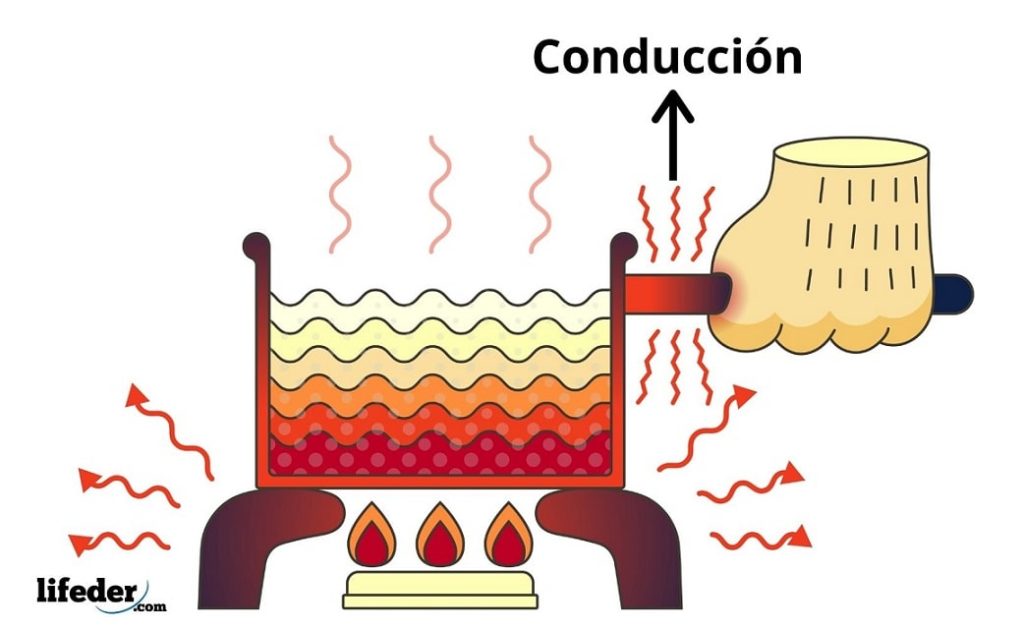
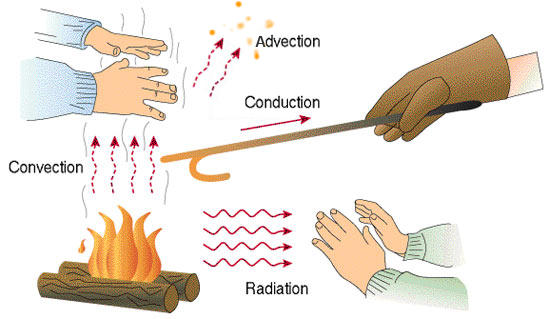
Conduction
noun
The process by which heat or electricity is directly transmitted through a substance when there is a difference of temperature or of electrical potential between adjoining regions, without movement of the material.
Example: The heat exchanger is insulated from its surroundings, the only heat exchange is between hot and cold fluids CONDUCTION along the walls is negligible
en: Conducción
consist of
Verb
be composed or made up of.
Example: It was discovered in tropical grasses and is now known to CONSIST OF 17 higher family plants, and includes many important crop species including maize and sugarcane
en: Consiste en
Convection
Noun
The movement caused within a fluid by the tendency of hotter and therefore less dense material to rise, and colder, denser material to sink under the influence of gravity, which consequently results in transfer of heat.
Example: U may be predicted from forced CONVECTION correlations.
en: Convección
Deal with
Noun
to accept or try to accept (something that is true and cannot be changed)
Example: Implementation Objective 4: Within 9 months 100% of insurance sector employees will be trained to DEAL WITH all five policies (except Life).
en: Tratar con
Fixed mass
Noun
It is a physical magnitude and general property of matter that expresses the inertia or resistance to change of motion of a body.
Example: Where the final solvent volume is not measured directly, a fixed mass of internal standard should be added to enable measurment of the volume, particularly for volumes less than 1 ml.
en: Masa Fija
Heat Transfer
Noun
Heat transfer is a discipline of thermal engineering that concerns the generation, use, conversion, and exchange of thermal energy (heat) between physical systems. Heat transfer is classified into various mechanisms, such as thermal conduction, thermal convection, thermal radiation, and transfer of energy by phase changes.
Example: On the surface deposits of materials can accumulate that reduce the HEAT TRANSFER and increase the pressure drop.
en: Transferencia de calor
inner surface
Noun
It is the area that is inside the system that is being evaluated
Example: Upon the INNER SURFACE of the envelope, Matrix protein or M1 coats the entire surface, stabilising the particle structure.
en: Superficie Interna
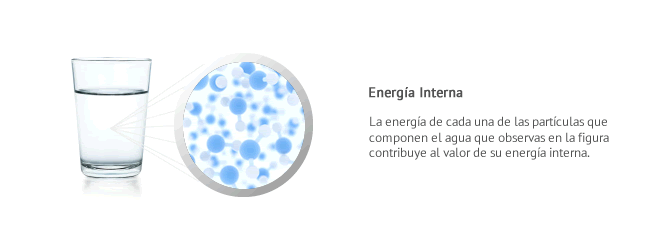
Internal energy
Noun
the energy in a system arising from the relative positions and interactions of its parts.
Example: The change in INTERNAL ENERGY (U) of the system is equal to the heat added (Q).
en: Energía Interna
mass transfer
Noun
Mass transfer is the net movement of mass from one location, usually meaning stream, phase, fraction or component, to another. Mass transfer occurs in many processes, such as absorption, evaporation, drying, precipitation, membrane filtration, and distillation.
Example: Movement of air across the crop allows for greater energy and MASS TRANSFER, mixing air from the mass of the atmosphere with the relatively still air directly around the plant.
en: Transferencia de masa
open system
Noun
a material system in which mass or energy can be lost to or gained from the environment.
Example: In contrast to this Bhaskar advanced the view that reality is an 'OPEN SYSTEM' in which causal mechanisms (like gravity) interact with other causal mechanisms and can interrupt their causal effects, therefore the manifestation of effects at the empirical level is contingent upon the interaction between unobservable entities.
en: Sistema abierto
outer surface
Noun
It is the area that is outside the system that is being considered
Example: The Biochemistry Of PhotosynthesisLight- Dependent Reaction (Fig 3): In both C 3 and C 4 plants, the chlorophyll molecules are arranged in the membranes of the thylakoids so that the haem group projects from the OUTER SURFACE.
en: Superficie Exterior
Radiation
Noun
The emission of energy as electromagnetic waves or as moving subatomic particles, especially high-energy particles which cause ionization.
Example: Monteith (1973) and many others have highlighted the agronomic importance of this relationship and the cumulative amount of solar RADIATION is often a good indicator of yield.
en: Radiación
Total energy
Noun
he total energy of a system is the sum of kinetic and gravitational potential energy, and this total energy is conserved in orbital motion.
Example: TOTAL ENERGY, E = KE + PE + FE Energy is expressed in Nm (SI units) Following the law of conservation, assuming no energy loss between two sections, then the energy at one section (1) must equal the energy at another section (2).
en: Energía Total
undergo
Verb
experience or be subjected to (something, typically something unpleasant, painful, or arduous).
Example: But for the CLS scholars whether a case is decided by rules or principles there will be inconsistency in the law; so the legal system has to UNDERGO a change.